Immortalized in Song
A one and a two and
Jonathan Mayhew Is In Town [click here]
Words by Nick Piombino; Song by Joe Massey
Distribution Automatique

Friday, April 22
"My Vocabulary did this to me"
is a famous quote from Jack Spicer,
purportedly uttered on his deathbed.
My Vocabulary {click here} is a new
blog sponsored by Matthew Shindell and
James Meetze, offering readings on
the UCSD college radio station at 4pm
Pacific Standard Time on Sundays.
This coming Sunday, April 24,
as announced here yesterday, we have been
asked to read, as has Ron Silliman.
Our sincere apologies for the shameless
self-promotion; we were unable to
post this link earlier due to blogger posting
problems.
I will mostly be
reading works originally
published on blogs and webzines,
including poems from my Chax chapbook,
*Hegelian Honeymoon*;
you may also be hearing some poems
from the PennSound website.
Hope you can tune in!
is a famous quote from Jack Spicer,
purportedly uttered on his deathbed.
My Vocabulary {click here} is a new
blog sponsored by Matthew Shindell and
James Meetze, offering readings on
the UCSD college radio station at 4pm
Pacific Standard Time on Sundays.
This coming Sunday, April 24,
as announced here yesterday, we have been
asked to read, as has Ron Silliman.
Our sincere apologies for the shameless
self-promotion; we were unable to
post this link earlier due to blogger posting
problems.
I will mostly be
reading works originally
published on blogs and webzines,
including poems from my Chax chapbook,
*Hegelian Honeymoon*;
you may also be hearing some poems
from the PennSound website.
Hope you can tune in!

Thursday, April 21
On The Radio
We are excited and delighted to
announce that we'll be reading,
with Ron Silliman, on Sunday,
April 24 at 4 P.M. on KSDT Radio {click here}
The show, hosted by Matthew Shindell
and James Meetze, has recently featured
Keith Waldrop and Rosemarie Waldrop
as well as the late great Robert Creeley.
We are excited and delighted to
announce that we'll be reading,
with Ron Silliman, on Sunday,
April 24 at 4 P.M. on KSDT Radio {click here}
The show, hosted by Matthew Shindell
and James Meetze, has recently featured
Keith Waldrop and Rosemarie Waldrop
as well as the late great Robert Creeley.
Wednesday, April 20
"The image persists
Of a childhood
Filled with happiness.
Don't ask why..."
Mike Keller
*To Be Sung*
BlazeVox [books]
Of a childhood
Filled with happiness.
Don't ask why..."
Mike Keller
*To Be Sung*
BlazeVox [books]
Tuesday, April 19
Forever Yours
One of the greatest pleasures of poetry is this art's
tendency to sustain or revive earlier forms. Although
poets everywhere are mourning the passing on of the
master lyric poet Robert Creeley, there is no need to be concerned about the death of the lyric form he so ably represented. Poets
like Elaine Equi and Mike Kelleher sing on.
Mike Keller's *To Be Sung* (BlazeVox [books], 2005) arrives on
the scene at a welcome moment. These compressed, short,
singing lyrics will be enjoyed by many Creeley fans. Creeley
himself wrote on the blurb: "Michael Kelleher's deft poems
have often a wry poignance and sing the old songs with
fresh particulars. So it's as ever where we are that
counts, and that's where these poems are, always."
Recalling another 20th century master of the short form,
Paul Celan, Kelleher writes:
"The glacial
Center
Radiates
Outward
Preserving
A few
Footprints
Frozen
In retreat."
Well, it's Spring, the weather's warm and
we're heading for Brighton Beach.
Think
I'l take
Kelleher's little
book
with
me.
One of the greatest pleasures of poetry is this art's
tendency to sustain or revive earlier forms. Although
poets everywhere are mourning the passing on of the
master lyric poet Robert Creeley, there is no need to be concerned about the death of the lyric form he so ably represented. Poets
like Elaine Equi and Mike Kelleher sing on.
Mike Keller's *To Be Sung* (BlazeVox [books], 2005) arrives on
the scene at a welcome moment. These compressed, short,
singing lyrics will be enjoyed by many Creeley fans. Creeley
himself wrote on the blurb: "Michael Kelleher's deft poems
have often a wry poignance and sing the old songs with
fresh particulars. So it's as ever where we are that
counts, and that's where these poems are, always."
Recalling another 20th century master of the short form,
Paul Celan, Kelleher writes:
"The glacial
Center
Radiates
Outward
Preserving
A few
Footprints
Frozen
In retreat."
Well, it's Spring, the weather's warm and
we're heading for Brighton Beach.
Think
I'l take
Kelleher's little
book
with
me.
Sunday, April 17
Jonathan Mayhew, whose blog Bemsha Swing
a favorite, is in town. Toni and me met him for coffee with
Gary Sullivan (Elsewhere) at the Mozart Cafe
(cool place with live piano music) on
West 70th St yesterday afternoon.
Jonathan lives in St Louis Mo,
and commutes to his teaching job in Kansas. Right
new he is on a sabbatical. He had his arms full
of books he bought at the Gotham Book Mart and
gifts he received from David Shapiro. Then we
all went to Central Park and had sandwiches
(bought from *Big Nick's* Burger Joint) at
Strawberry Fields. Julia Mayhew {click here},
also a poet-blogger,
was unable to join her father due to a busy schedule at
home. Next stop for Jonathan: a reading by blogger
Jordan Davis (Equanimity)
today, and back home on Tuesday.
It was a delight to meet Jonathan, whose blog
we read daily. Jonathan and me go back a long
way: he taught me (by email) how to post links! Jonathan,
come back soon!
************************************************
Excellent report from Robert Adamson on a visit to Sydney, Australia by Robert Creeley in 1976 in Jacket {click here}
************************************************
Hundreds of
Fragments of Classical Literature Deciphered {click here}
a favorite, is in town. Toni and me met him for coffee with
Gary Sullivan (Elsewhere) at the Mozart Cafe
(cool place with live piano music) on
West 70th St yesterday afternoon.
Jonathan lives in St Louis Mo,
and commutes to his teaching job in Kansas. Right
new he is on a sabbatical. He had his arms full
of books he bought at the Gotham Book Mart and
gifts he received from David Shapiro. Then we
all went to Central Park and had sandwiches
(bought from *Big Nick's* Burger Joint) at
Strawberry Fields. Julia Mayhew {click here},
also a poet-blogger,
was unable to join her father due to a busy schedule at
home. Next stop for Jonathan: a reading by blogger
Jordan Davis (Equanimity)
today, and back home on Tuesday.
It was a delight to meet Jonathan, whose blog
we read daily. Jonathan and me go back a long
way: he taught me (by email) how to post links! Jonathan,
come back soon!
************************************************
Excellent report from Robert Adamson on a visit to Sydney, Australia by Robert Creeley in 1976 in Jacket {click here}
************************************************
Hundreds of
Fragments of Classical Literature Deciphered {click here}
Friday, April 15
1998
Thanks to Geof Huth- dbqp visualizing poetics {click here}
for his review of our collage *1998* in the Dudley House *Infinity Show *
(see sidebar)
******************************************************
Wisdom: does it consist of little more than accepting how long it takes for
something to actually 'happen'? If satisfaction is the measure this is easy to see.
*
Perfection is a kind of surface. Wholeness must be bounded by a shell or skin. To be a unit is to have an outside and an inside.
*
Place your bets, then laugh. And the game comes to an end so soon!
*
In case you might forget, exagerrate.
*
Adhering to the world by means of glue, ideas are useful mainly when they're wet. But the dry remains fascinate.
*
Reality is like a sea.
*
The world contains many thoughts and few images.
from *The Boundary of Blur*
Roof, 1993
Thanks to Geof Huth- dbqp visualizing poetics {click here}
for his review of our collage *1998* in the Dudley House *Infinity Show *
(see sidebar)
******************************************************
Wisdom: does it consist of little more than accepting how long it takes for
something to actually 'happen'? If satisfaction is the measure this is easy to see.
*
Perfection is a kind of surface. Wholeness must be bounded by a shell or skin. To be a unit is to have an outside and an inside.
*
Place your bets, then laugh. And the game comes to an end so soon!
*
In case you might forget, exagerrate.
*
Adhering to the world by means of glue, ideas are useful mainly when they're wet. But the dry remains fascinate.
*
Reality is like a sea.
*
The world contains many thoughts and few images.
from *The Boundary of Blur*
Roof, 1993
Tuesday, April 12
Marianne Shaneen
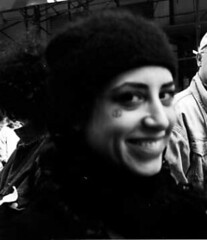
Marianne Shaneen
"the heart of the inanimate camera got bigger and bigger hungrier and hungrier
it ate the town, it ate Africa, then America, then it ate General Electric
what happens off-screen
gives intimations of an artificial night
lightbulbs break, shattered sugar spills between frames
sweetening the oscilloscopic palindrome grist
of whirling circles in the night consumed by fire
wearing a film ring that measures the dose of radiation
the sun suffers from psychologically-induced blindness
Prometheus puts his eyes over his hands
last words *more light*"
from *Lucent Amnesis*
Portable Press at Yo-Yo Labs
2005
Tonight!
Come hear Marianne Shaneen read at Bar Reis
this from Marianne Shaneen:
Hope to see you on Tuesday....
here are directions to Bar Reis
take the F, N or R train to the “4th Ave. & 9th St.” stop in Brooklyn (Park Slope). go 1 block to 5th Ave, turn left and walk two blocks down 5th avenue, it’s between 5th and 6th Streets. (375 5th Ave).
Dear friends, come celebrate your refusal to pay taxes this year with a great reading...
I’d love to see you,
happy spring!
Marianne
The BBR Reading Series
PRESENTS
Marianne Shaneen
&
Christopher Stackhouse
Tuesday April 12, 8pm
Bar Reis
375 5th Avenue
(btwn 5th & 6th Streets)
BROOKLYN
718-832-5716
(F train to 4th and 9th)
Marianne Shaneen is a writer and filmmaker. Her new chapbook Lucent Amnesis has just been released from Yo-Yo Labs.
Her poems and fictions have appeared in Crayon, The Hat, Snare, The Beehive Hypermedia Journal, Faux/e, and are forthcoming in VANITAS.
Recent publications include “Inhabiting the Impossible”, an essay in INTERFACES (ed. Jean-Michel Rabaté) on the architectural poetics of Madeline Gins and Arakawa. Her essay on the occult and avant garde cinema is forthcoming in the book Monstrous Adaptations from Manchester University Press.
She recently organized a benefit for the Critical Art Ensemble and co-curates the Robert Beck Memorial Cinema film screening series in NYC.
She’s currently making a documentary film and lives in Brooklyn.
***
Christopher Stackhouse's images and text have been published in Bridge Magazine, Aufgabe, Fence, Hambone, nocturnes (re) view of the literary arts, The Village Voice, NY Arts, Swerve, and Big Fish. His drawings with the text-in-dialogue of writer John Keene was published in the limited edition artist book *Seismosis* by The Center For Book Arts in 2003. He is a poetry editor for Fence Magazine. He curates and hosts The Friday Night Series at The Poetry Project in St. Mark's Church, and The First Tuesdays Readings at A Taste of Art Cafe/Gallery in New York City.
Stackhouse, a father of two daughters, lives in Park Slope, Brooklyn.
***
Sunday, April 10
Swooning
Blogger's been down for awhile, plus I've
been spending a lot of time at Brighton
Beach, enjoying the first sunshine I've
seen and felt as long as I can remember!
Today, Gary Sullivan delivered my copy
of his new comic *Elsewhere* and, not
only is it "interesting" as is said of so many works
of this type, but it is actually funny! And brilliant. All the
words and images were found on Nada and Gary's
honeymoon in Tokyo.
It is a joy to have and to look at, and
a fascinating read.
If you liked *Swoon*, the courtship, you'll
love *Elsewhere*, the honeymoon.
Go to Elsewhere {click here} and order it right now. You'll be so glad you did.
Had a chance to view Nico Vassilakis'
new poetry movie, *Concrete: Movies*
As soon as you've finished writing
your check for Gary's comic, write
one for Nico's movie dvd. It consists
of 5 movies, 51 minutes, some in color, some in
black and white, one with sound, some
with letters, some with numbers, some
with lines, some where you can see
the hand handling a pen and drawing,
all completely abstract and non-narrative.
Now, you've got clear picture of this dvd,
right? No way. You have to see this
excellent film to believe it. All for $8!
Write to
Nico Vassilakis
3046 61st Avenue SW
Seattle, WA 98116
shoehorns@msn.com
Also coming soon, a few words about:
*Lucent Amnesis* by Maryanne Shaneen (Portable Press, 2005)
*Indigo Bunting* by Bernadette Mayer (Zasterle, 2004)
*Artificial Lure* by Clayton Couch (Effing Press, 2005)
*Private Lemonade* by John Godfrey (Adventures in Poetry, 2003)
*The Frequencies* by Noah Eli Gordon (Tougher Disguises, 2003)
*Youth, A Crevice* (and other chapbooks) by Brother Tom Murphy (Cat Press, 2005)
*To Be Sung* by Michael Kelleher (BlazeVox, 2005)
*Folding Architecture* by Sophia Vyzoviti (Ginko Press, 2003)
*Interfaces: Architecture Against Death* by Arakawa and Gins (Holy Cross University, 2 Volumes, 2003)
Now let's see if Blogger is actually working again!
Blogger's been down for awhile, plus I've
been spending a lot of time at Brighton
Beach, enjoying the first sunshine I've
seen and felt as long as I can remember!
Today, Gary Sullivan delivered my copy
of his new comic *Elsewhere* and, not
only is it "interesting" as is said of so many works
of this type, but it is actually funny! And brilliant. All the
words and images were found on Nada and Gary's
honeymoon in Tokyo.
It is a joy to have and to look at, and
a fascinating read.
If you liked *Swoon*, the courtship, you'll
love *Elsewhere*, the honeymoon.
Go to Elsewhere {click here} and order it right now. You'll be so glad you did.
Had a chance to view Nico Vassilakis'
new poetry movie, *Concrete: Movies*
As soon as you've finished writing
your check for Gary's comic, write
one for Nico's movie dvd. It consists
of 5 movies, 51 minutes, some in color, some in
black and white, one with sound, some
with letters, some with numbers, some
with lines, some where you can see
the hand handling a pen and drawing,
all completely abstract and non-narrative.
Now, you've got clear picture of this dvd,
right? No way. You have to see this
excellent film to believe it. All for $8!
Write to
Nico Vassilakis
3046 61st Avenue SW
Seattle, WA 98116
shoehorns@msn.com
Also coming soon, a few words about:
*Lucent Amnesis* by Maryanne Shaneen (Portable Press, 2005)
*Indigo Bunting* by Bernadette Mayer (Zasterle, 2004)
*Artificial Lure* by Clayton Couch (Effing Press, 2005)
*Private Lemonade* by John Godfrey (Adventures in Poetry, 2003)
*The Frequencies* by Noah Eli Gordon (Tougher Disguises, 2003)
*Youth, A Crevice* (and other chapbooks) by Brother Tom Murphy (Cat Press, 2005)
*To Be Sung* by Michael Kelleher (BlazeVox, 2005)
*Folding Architecture* by Sophia Vyzoviti (Ginko Press, 2003)
*Interfaces: Architecture Against Death* by Arakawa and Gins (Holy Cross University, 2 Volumes, 2003)
Now let's see if Blogger is actually working again!
Friday, April 8
"Suppose I was to postulate that being a writer is absolutely ludicrous"
is one of my favorite lines from Richard Foreman's current play
*The Gods Are Pounding My Head (AKA Lumberjack Messiah).*
Another line that makes me think: "In bad times the best that can
be done is to fail (is that what I believe. Even if I believe...)"
I kept jotting lines down from the play throughout, because in
this work, more than in any I can remember, Richard Foreman
appears to want to address the current circumstances
of life, in words, more directly than in any of his plays I can remember, going
back to the late 60's. "How can I activate my heart?" is another
line that surprised me. "Don't touch the big heart. Why can't
I see it?" "The action is elsewhere....Wake up into a world
where people are thin somehow." This line, which repeats
throughout the play, hits the nail on the head of contemporary
existence, for me. Also, throughout the play, two words are repeated
again and again, in varying contexts. These are: "tendency" and
"fidget."
Yet it's important to add that in this work, as in all his plays, words
and statements themselves are problematized. All of Foreman's plays,
perhaps a little less so in this one, make it clear that we
are always saying the same things, but these things are constantly
meaning something else. "We can never go into the future which
is behind us," and, "It's the world itself making these choices
on your behalf," are two paradoxes worthy of the description
"koan." The fact that everything said is also clearly directed to
himself makes this playwright worthy of the title philosopher, and this
line clinched it: "OK Richie, what do we do
with these things?"
is one of my favorite lines from Richard Foreman's current play
*The Gods Are Pounding My Head (AKA Lumberjack Messiah).*
Another line that makes me think: "In bad times the best that can
be done is to fail (is that what I believe. Even if I believe...)"
I kept jotting lines down from the play throughout, because in
this work, more than in any I can remember, Richard Foreman
appears to want to address the current circumstances
of life, in words, more directly than in any of his plays I can remember, going
back to the late 60's. "How can I activate my heart?" is another
line that surprised me. "Don't touch the big heart. Why can't
I see it?" "The action is elsewhere....Wake up into a world
where people are thin somehow." This line, which repeats
throughout the play, hits the nail on the head of contemporary
existence, for me. Also, throughout the play, two words are repeated
again and again, in varying contexts. These are: "tendency" and
"fidget."
Yet it's important to add that in this work, as in all his plays, words
and statements themselves are problematized. All of Foreman's plays,
perhaps a little less so in this one, make it clear that we
are always saying the same things, but these things are constantly
meaning something else. "We can never go into the future which
is behind us," and, "It's the world itself making these choices
on your behalf," are two paradoxes worthy of the description
"koan." The fact that everything said is also clearly directed to
himself makes this playwright worthy of the title philosopher, and this
line clinched it: "OK Richie, what do we do
with these things?"
Wednesday, April 6
Pancake People
Richard Foreman included some notes in the playbill that will
be quoted extensively here later when I have the time to write
more- in a rush right now. But think about this: "...today, I see
within us all (myself included) the replacement of complex inner
density with a new kind of self- evolving under the pressure of information
overload and the technology of the 'instantly available.' A new self
that needs to contain less and less of an inner repertory of dense
cultural inheritance- as we all become "pancake people"- spread
wide and thin as we connect with that vast network of information
accessed by the mere touch of a button."
The Gods Are Pounding My Head (AKA Lumberjack Messiah)
by Richard Foreman is a joy to behold. Sadly, I have no time
to write about this further now, but if you do nothing else today-
call and make a reservation for this play- reputed to possibly
Foreman's final contribution in this form that he has been working
in since 1968- the completely live staged play- and towards
a form that includes more multimedia elements. We'll see about
that- but either way- make sure to see this wonderfully performed,
gorgeously staged, intensely thought-provoking work.
ontological-hysteric theater {click here}
Richard Foreman included some notes in the playbill that will
be quoted extensively here later when I have the time to write
more- in a rush right now. But think about this: "...today, I see
within us all (myself included) the replacement of complex inner
density with a new kind of self- evolving under the pressure of information
overload and the technology of the 'instantly available.' A new self
that needs to contain less and less of an inner repertory of dense
cultural inheritance- as we all become "pancake people"- spread
wide and thin as we connect with that vast network of information
accessed by the mere touch of a button."
The Gods Are Pounding My Head (AKA Lumberjack Messiah)
by Richard Foreman is a joy to behold. Sadly, I have no time
to write about this further now, but if you do nothing else today-
call and make a reservation for this play- reputed to possibly
Foreman's final contribution in this form that he has been working
in since 1968- the completely live staged play- and towards
a form that includes more multimedia elements. We'll see about
that- but either way- make sure to see this wonderfully performed,
gorgeously staged, intensely thought-provoking work.
ontological-hysteric theater {click here}
Monday, April 4
"Winners"
"If, as is often said, you can't win, it is perhaps because
when you do you have so much to lose. To put it a
little gloomily winning could be called the mark of Abel.
It would be beautiful to photograph the winners of anything
from Nobel prize to booby prize, clutching trophy or money
or certificate, solemn or smiling or bloody, on the
precarious pinnacle of the human landscape."
Text for a project on winners from
Diane Arbus 1962 notebook (No. 8)
[Copied at the Diane Arbus show now
up at the Metropolitan Museum. A
must-see without doubt!]
"If, as is often said, you can't win, it is perhaps because
when you do you have so much to lose. To put it a
little gloomily winning could be called the mark of Abel.
It would be beautiful to photograph the winners of anything
from Nobel prize to booby prize, clutching trophy or money
or certificate, solemn or smiling or bloody, on the
precarious pinnacle of the human landscape."
Text for a project on winners from
Diane Arbus 1962 notebook (No. 8)
[Copied at the Diane Arbus show now
up at the Metropolitan Museum. A
must-see without doubt!]
Sunday, April 3
*Blade Runner* Rides Again
I was at home sick with a aching, sneezy cold
on a gray, incessantly rainy day and
happened to have gotten to the library recently
and pulled a book off the shelf that wierdly
felt like I already knew all about it, and
in a way, I did. The book is resonant with
concepts of deja vu, and problematizes
memory in ways that Proust is famous for,
though sadly I find that eminent author impossible
to read. This book I found is the kind that
can make you glad you have a terrible cold, almost.
Also, if you're a Phillip K. Dick fan, or
a *Blade Runner* fan, you definitely will
want to check out
Los Angeles {click here} by Peter Moore Smith, a novel
I enjoyed almost, but not quite, as much as Grant Bailie's *Cloud 8* and
for similar reasons. First of all, it's a page turner, and secondly
it deals with a lonely figure whose effort to figure out love,
life and the world takes you into unexpected regions. In
this case that region is Los Angeles, a mythical Hollywood
that exists as much in the imagination of the world as it does
in the mind of the central character of this striking second novel.
The main character is an albino who is misogynistic, drug
and alcohol addicted, but, in his own way, as charming as Salinger's Holden
Caulfield. One of his quirks is leaving *Blade Runner* on
on his TV all the time, something I nearly did myself for many years
(the Ridley Scott movie came out in the early 80's).
Who knows, Angel may become this generation's "Catcher in the Rye"
(of course, this one is 30, not 16)
whose attitudes cut right through all the contemporary platitudes about
money, love, religion and politics. What happens is that rich, lonely albino Angel
(his father is a fabulously wealthy movie director) gets visited by
sultry, electrifying, black Angela, who then disappears,
making Angel (himself, a putative screen writer) a
Blade Runner in reverse; he has to find Angela to save her.
His travels take us through the underside of Hollywood as a metaphor
for contemporary existence, most pointedly, family, memory, and the agonizing
process of maturation. The tough, noir language is as irrisistible
as a second scotch on a lonely night. And it's as hard to book this book down
as it is for Angel to put a bottle of pills down; the trip is wild, and worth it.
I was at home sick with a aching, sneezy cold
on a gray, incessantly rainy day and
happened to have gotten to the library recently
and pulled a book off the shelf that wierdly
felt like I already knew all about it, and
in a way, I did. The book is resonant with
concepts of deja vu, and problematizes
memory in ways that Proust is famous for,
though sadly I find that eminent author impossible
to read. This book I found is the kind that
can make you glad you have a terrible cold, almost.
Also, if you're a Phillip K. Dick fan, or
a *Blade Runner* fan, you definitely will
want to check out
Los Angeles {click here} by Peter Moore Smith, a novel
I enjoyed almost, but not quite, as much as Grant Bailie's *Cloud 8* and
for similar reasons. First of all, it's a page turner, and secondly
it deals with a lonely figure whose effort to figure out love,
life and the world takes you into unexpected regions. In
this case that region is Los Angeles, a mythical Hollywood
that exists as much in the imagination of the world as it does
in the mind of the central character of this striking second novel.
The main character is an albino who is misogynistic, drug
and alcohol addicted, but, in his own way, as charming as Salinger's Holden
Caulfield. One of his quirks is leaving *Blade Runner* on
on his TV all the time, something I nearly did myself for many years
(the Ridley Scott movie came out in the early 80's).
Who knows, Angel may become this generation's "Catcher in the Rye"
(of course, this one is 30, not 16)
whose attitudes cut right through all the contemporary platitudes about
money, love, religion and politics. What happens is that rich, lonely albino Angel
(his father is a fabulously wealthy movie director) gets visited by
sultry, electrifying, black Angela, who then disappears,
making Angel (himself, a putative screen writer) a
Blade Runner in reverse; he has to find Angela to save her.
His travels take us through the underside of Hollywood as a metaphor
for contemporary existence, most pointedly, family, memory, and the agonizing
process of maturation. The tough, noir language is as irrisistible
as a second scotch on a lonely night. And it's as hard to book this book down
as it is for Angel to put a bottle of pills down; the trip is wild, and worth it.
Saturday, April 2
That Chicago Sound
Elaine Equi, Kimberly Lyons and
Sharon Mesmer wrote to us regarding
our post *The Chicago School* in
reponse to Sharon Mesmer and Elaine
Equi's recent reading at the Bowery
Poetry Club. Elaine wrote:
"...I think you're right, there is a Chicago sound -- funny, talky, kind of
surreal (they were big there for a while)."
Kimberly Lyons sent us the following response.
"Hi Nick,
I'm sweating cuz such a casual remark to you bloggers leads to a thing. Keeps us on our toes!
Sure, I was a freshman and Elaine a senior so to speak at Columbia College. A few years later Sharon Mesmer, and Debbie Pintonelli and Connie Deanovitch came to Columbia. We all studied with Paul Hoover and in some sense Maxine Chernoff. But there wasn't a school. Not sure how much social interaction there was of any of the aforementioned parties until NYC. There certainly are shared concerns through time in the work and styles if you will among these writers and many more - but I know most of them would resist identification as "Chicago" writers.
Elaine E and Jerome S. were at one time part of and even originators of a scene that I think came off of a punk and performance and various literary affilitations . Their work and audiences became inclusive of LA cohorts that I think involved Amy Gerstler, David Trinidad and others. Once they moved east and after years of intensive individual work they are quite independent and have even individuated from each others work! I think their work now needs to be read in the context of the New York School, including Ron Padgett, Elmslie and Brainard; Lang( and 2nd generation lang po) including Bruce Andrews, Rob Fittterman, Rae Armentrout and many other affilitations that criss-cross coteries. Equi and Sala's early work did manifest that cluster of characteristics you listed --as does Sharon Mesmer's work. The divergences and sympathies among these writer's work would be a longer dialogue and reading. Worth doing.
The Chicago poetry scene and the style you allude to or are trying to define, takes its energy, I think, from Chicago's particular working class politics, African American culture (think of the avante garde African American jazz performers coming out of Chicago), comedy, and Chicago's longtime involvement with surrealism - from Breton's famous visit to Maxwell Street to the collecting of the Bergmans; the centerpiece of the Art Institute's Cornell collection. When I was a teen, it was big news when Franklin Rosemont's group threw flour all over Robert Bly at a reading at the Body Politic. The Chicago Imagist painters work also reflects these forces: Big Table magazine, The Little magazine, even Poetry and the Chicago Literary Review and vestiges of other literary scenes has energized activity- even in the ephemeral way of these histories. The brief presence of Ted Berrigan and Alice Notley in Chicago instigated, I believe, a whole new opening up of styles and Barbara Barg, Susie Timmons, Bob Holman, Bob Rosenthal, Shelley Kraut's commitment to poetry and their later moving east. The 15 Chicago Poets group (my tag) are an intereresting constellation. Art Lange's Brilliant Corners, for instance, is a great unsung magazine. Anyway, this is a larger situation and I'm not making a claim for any of the writers' work mentioned as being subsumed in this context - more as being in an unavoidable relationship. My own and Sharon's work, as is evident from her great new collection of stories form Hanging Loose, I think remains haunted by the geography of the experience. The look and feel of things there....
yours, Kim"
Elaine Equi, Kimberly Lyons and
Sharon Mesmer wrote to us regarding
our post *The Chicago School* in
reponse to Sharon Mesmer and Elaine
Equi's recent reading at the Bowery
Poetry Club. Elaine wrote:
"...I think you're right, there is a Chicago sound -- funny, talky, kind of
surreal (they were big there for a while)."
Kimberly Lyons sent us the following response.
"Hi Nick,
I'm sweating cuz such a casual remark to you bloggers leads to a thing. Keeps us on our toes!
Sure, I was a freshman and Elaine a senior so to speak at Columbia College. A few years later Sharon Mesmer, and Debbie Pintonelli and Connie Deanovitch came to Columbia. We all studied with Paul Hoover and in some sense Maxine Chernoff. But there wasn't a school. Not sure how much social interaction there was of any of the aforementioned parties until NYC. There certainly are shared concerns through time in the work and styles if you will among these writers and many more - but I know most of them would resist identification as "Chicago" writers.
Elaine E and Jerome S. were at one time part of and even originators of a scene that I think came off of a punk and performance and various literary affilitations . Their work and audiences became inclusive of LA cohorts that I think involved Amy Gerstler, David Trinidad and others. Once they moved east and after years of intensive individual work they are quite independent and have even individuated from each others work! I think their work now needs to be read in the context of the New York School, including Ron Padgett, Elmslie and Brainard; Lang( and 2nd generation lang po) including Bruce Andrews, Rob Fittterman, Rae Armentrout and many other affilitations that criss-cross coteries. Equi and Sala's early work did manifest that cluster of characteristics you listed --as does Sharon Mesmer's work. The divergences and sympathies among these writer's work would be a longer dialogue and reading. Worth doing.
The Chicago poetry scene and the style you allude to or are trying to define, takes its energy, I think, from Chicago's particular working class politics, African American culture (think of the avante garde African American jazz performers coming out of Chicago), comedy, and Chicago's longtime involvement with surrealism - from Breton's famous visit to Maxwell Street to the collecting of the Bergmans; the centerpiece of the Art Institute's Cornell collection. When I was a teen, it was big news when Franklin Rosemont's group threw flour all over Robert Bly at a reading at the Body Politic. The Chicago Imagist painters work also reflects these forces: Big Table magazine, The Little magazine, even Poetry and the Chicago Literary Review and vestiges of other literary scenes has energized activity- even in the ephemeral way of these histories. The brief presence of Ted Berrigan and Alice Notley in Chicago instigated, I believe, a whole new opening up of styles and Barbara Barg, Susie Timmons, Bob Holman, Bob Rosenthal, Shelley Kraut's commitment to poetry and their later moving east. The 15 Chicago Poets group (my tag) are an intereresting constellation. Art Lange's Brilliant Corners, for instance, is a great unsung magazine. Anyway, this is a larger situation and I'm not making a claim for any of the writers' work mentioned as being subsumed in this context - more as being in an unavoidable relationship. My own and Sharon's work, as is evident from her great new collection of stories form Hanging Loose, I think remains haunted by the geography of the experience. The look and feel of things there....
yours, Kim"
Creeley Memorial Reading on The Radio
Matthew Shindell and James Meetze's new show
will open with readings from Robert Creeley
and some tributes from Timothy Yu and others
KSDT radio.org {click here}
on Sunday, April 3rd from 4-6 pm
via
wood s lot {click here}
Matthew Shindell and James Meetze's new show
will open with readings from Robert Creeley
and some tributes from Timothy Yu and others
KSDT radio.org {click here}
on Sunday, April 3rd from 4-6 pm
via
wood s lot {click here}
Friday, April 1
Transitions
Learning, finding, understanding, unraveling, working through:
all require patience, that transitional music between one melody
and the next. Every success, no matter how large or small
requires it, not just to locate the switch that turns on the lightbulb of
inspiration, but to then find a way to illuminate the room and the landscape
that are to be transformed by the benefits of such enlightenment.
Even procrastination has within it a tiny germ of how
this kind of waiting ought to feel.
All this rushing around is destroying everything: affection, charm,
connection- every possible accomplishment. Contemporary life
never ceases to conspire to deflect us from the one activity that can't
fail to bring us closer to all that we most need and want: real thinking.
Learning, finding, understanding, unraveling, working through:
all require patience, that transitional music between one melody
and the next. Every success, no matter how large or small
requires it, not just to locate the switch that turns on the lightbulb of
inspiration, but to then find a way to illuminate the room and the landscape
that are to be transformed by the benefits of such enlightenment.
Even procrastination has within it a tiny germ of how
this kind of waiting ought to feel.
All this rushing around is destroying everything: affection, charm,
connection- every possible accomplishment. Contemporary life
never ceases to conspire to deflect us from the one activity that can't
fail to bring us closer to all that we most need and want: real thinking.
Wednesday, March 30
The Best Minds
"I saw the best minds of my generation destroyed
by madness, starving, hysterical, naked..."
Allen Ginsberg
"In art, there is all too much thinking about liking
and disliking."
Jackson Mac Low
For quite awhile now I’ve been postponing reading
*The Best American Poetry 2004* edited by Lyn Hejinian,
though I knew I would, inevitably. How could I ignore a
project like this from such a first-rate mind?
I took it home from the library today, and I dipped into it
and thought: this is going to be difficult. Of course, there are
the expectable ideas or reactions about not having been
included, any poet might feel this. But, as I read through it, I realized
a few of the reasons that I have had some problems reading
AND writing poetry, especially of late. For a very long time, especially since
9/11, I’ve noticed that I frequently avoid newspapers,
news broadcasts, sad movies and many other things
that might depress me. (By the way, my work as a
therapist does not at all affect me this way – on the
contrary, it is stimulating and interesting because I find
doing therapy intensely engrossing,
more and more over time, especially
because I enjoy learning and most of all following
and trying to assist the process of change.)
As soon as I began to read the book, it occurred
to me that a great deal of contemporary poetry continually
reflects on disillusionment and suffering, and not
a little of it, including much of my own recent work
focuses on the hardships of being a poet.
I am tired of thinking about this. I think about it
all the time. It feels like I have always thought
about this all the time. I closed the book and considered
writing a satiric parody of a contemporary poem. But
oh please, not that again! So I reopened the
book and continued reading here and there.
Then, as I paged through the book, I got an idea.
I thought of pulling out one sad, depressed, angry,
bitter or tragic line from each poem. At first I
did this in a provocative or critical way, but then
it became a way of reading the book with an eye
towards insight. While thinking about the work in
this way, I discovered that the book is, in fact,
very worthwhile reading, an absorbing assemblage
of poetic minds and approaches to writing
and thinking about poetry; and also, that the
overall selection does connect; and very beautifully
so. In this manner I forced myself to read each and every
poem completely , though quickly, in order to select the one
line or phrase from each work to include here.
It's interesting also to note, that
when I have read a book of poems in this way, I will
inevitably return to it, as I have made my acquaintance
now with the poems (and in a number of cases, the
poets), and I have become curious about getting to know
them better. (The obvious benefit of a useful anthology).
Finally, I constructed a title from two of the lines.
*****************************************************
“Going Toward Nothing”: “The Self-Stung Unfolding”
(Lines from The Best American Poetry of 2004, edited by Lyn Hejinian)
“she should have stayed in her little cage
shat on by her sisters above her” (15)
“Not some writhing in a tortuous canine presence” (17)
“tighten up your resumé sphincter living for a better suicide” (22)
“Almost all the words we’ve said to one another are gone” (26)
“bombing another car…you so hate” (29)
“Now see the damage” (31)
“We were going toward nothing/all along” (32)
“Does something for everyone mean nothing for anyone” (34)
“Memory is to life like a band-aid to a wound” (38)
“I know I’m fucked” (43)
“…he went ballistic” (45)
“’From those who have nothing, even what they have
will be taken away,’ I thought” (46)
“I am on a drive where a mirror has collapsed” (48)
“his face a glass that has shattered but not yet fallen” (51)
“…the city on the hill having failed us” (54)
“It is difficult to describe what we felt” (55)
“who’s pushing who?” (58)
“-your negligence constantly reminds-“ (59)
“and there’s plenty to be unhappy about” (61)
“*I am wretched*” (63)
“stunned from the sleep of a Nobody” (66)
“Inducing doubt and self-hatred in all you come into contact with” (71)
“sent out a feeble cry signifying
grief and confusion, et cetera” (73)
“its heartless calculation, its profound sadness” (78)
“something dirty, something you only do if you are sick and caught in deep clots of blood” (81)
“Adolf Hitler’s radio rant” (85)
“Desperate to see themselves as merry/
In the mirror they carry around with them” (88)
“I returned your book of poetry to the store/
I returned to the scene of the crime” (90)
“Molten days, because of lingering
Nothing’s personal, including yours” (93)
“I have lost the doves of Milan, floating politely” (94)
“Baby would be raped or murdered by now
kidnapped or placed in a holding cell at the police station…” (99)
“*I think I know, but the world’s still mum*” (109)
“Anything can happen under these conditions. Nuclear bombs, dirty/ bombs, small time random murder, and abduction” (117)
“and then everyone gone and not found” (123)
“the beginning of a sentient, formless life” (125)
“I am none but the king of sad persuasion” (126)
“I heard a voice saying ‘Blundering
Coma dancing wild ineptitude…” (131)
“The speculations of that secret self/
For whom to even try to talk to you is death” (134)
“…a replenished body
singing its way into doubletalk” (136)
“Dark passages wait for us…” (142)
“And still we did not speak, did
not know to whom to speak…” (146)
“…a republic of none, the one included/us,/
no one to speak it with, dumbstruck” (148)
“no longer dreaming plowing on through thick mud” (153)
“Perhaps Paul Celan is the crematorium built
especially for Language poets” (161)
“…frozen in terror” (169)
“Is bad weather coming/
how would we know/
Is bad weather coming
call everyone” (174)
“an era of night sweats, gasps and pants” (177)
“the paranoia I feel about all the award
winners
I’m like king of the losers again” ( 179)
“why is the president so popular? because he is vicious” (184)
‘Like an x-ray of infant bronchitis. Wrist slitting stuff” (186)
“Don’t invite me to your pity party.
Don’t call me up on your pity party line
and invite me over for punch and cookies.
I won’t come…” (187)
“terrible vision. I don’t think I can fall asleep” (188)
“a terror that being emperor in no matter how many other brains/can’t squash” (191)
“but nothing sticks, that doesn’t/
have to. Not memory;
not the naming…”(193)
“City of healers and cheaters” (195)
“Your themes/ are plein-air/ endless/ sad.” (197)
“jumping in flames from roaring height for a fooled god/
and his cow disease of long rotting memories” (198)
“Don’t look here for a view
the ice will just cream all over you
latency barometer zero” (201)
“on I trouble raped” (204)
“listen to me./ mirrordown./ these notions are halfbaked understand/
it’s just what’s right/ I’m tired just let me rest” (206)
“The melanoma on my skin
Resumes what’s wrong with me within” (207)
“In the injured house
made of local sun and stone-
In the city of numbers
Which everyone counts and hates and wants-“ (214)
“Lines link lives like words,
glances, an embrace, capable
entirely of administration, deceit,
want, need, the long sigh,
meaning evident to no one.” (223)
“*slowly, poetry had failed me*” (224)
“People are like ciphers. They say this. They say that.” (227)
“just a mistake- I scream outright at the likeness.” (228)
“…when the sky opens up/
and pelts the earth with a momentary lapse of crying.” (229)
“eighteen women in singular postures of
mourning along the sides of the sarphagus;” (231)
“The sudden pressure to
act normal was killing me.” (233)
“..inventing a paranoia into the sleepless
monster that is this bastard maggot poetry.” (236)
“Raucous how fun to rip it apart soon…
Poetry scene lurker as mass-popular unit.” (240)
“We who love precise language
Need a finer way to convey
Disappointment and perplexity.” (241)
“And the chorus of tone-deaf guards is bellowing
Lock down and Body Search! Silence and Lights Out!” (243)
“Nothings undoing among the self-stung unfolding of things.” (244)
"I saw the best minds of my generation destroyed
by madness, starving, hysterical, naked..."
Allen Ginsberg
"In art, there is all too much thinking about liking
and disliking."
Jackson Mac Low
For quite awhile now I’ve been postponing reading
*The Best American Poetry 2004* edited by Lyn Hejinian,
though I knew I would, inevitably. How could I ignore a
project like this from such a first-rate mind?
I took it home from the library today, and I dipped into it
and thought: this is going to be difficult. Of course, there are
the expectable ideas or reactions about not having been
included, any poet might feel this. But, as I read through it, I realized
a few of the reasons that I have had some problems reading
AND writing poetry, especially of late. For a very long time, especially since
9/11, I’ve noticed that I frequently avoid newspapers,
news broadcasts, sad movies and many other things
that might depress me. (By the way, my work as a
therapist does not at all affect me this way – on the
contrary, it is stimulating and interesting because I find
doing therapy intensely engrossing,
more and more over time, especially
because I enjoy learning and most of all following
and trying to assist the process of change.)
As soon as I began to read the book, it occurred
to me that a great deal of contemporary poetry continually
reflects on disillusionment and suffering, and not
a little of it, including much of my own recent work
focuses on the hardships of being a poet.
I am tired of thinking about this. I think about it
all the time. It feels like I have always thought
about this all the time. I closed the book and considered
writing a satiric parody of a contemporary poem. But
oh please, not that again! So I reopened the
book and continued reading here and there.
Then, as I paged through the book, I got an idea.
I thought of pulling out one sad, depressed, angry,
bitter or tragic line from each poem. At first I
did this in a provocative or critical way, but then
it became a way of reading the book with an eye
towards insight. While thinking about the work in
this way, I discovered that the book is, in fact,
very worthwhile reading, an absorbing assemblage
of poetic minds and approaches to writing
and thinking about poetry; and also, that the
overall selection does connect; and very beautifully
so. In this manner I forced myself to read each and every
poem completely , though quickly, in order to select the one
line or phrase from each work to include here.
It's interesting also to note, that
when I have read a book of poems in this way, I will
inevitably return to it, as I have made my acquaintance
now with the poems (and in a number of cases, the
poets), and I have become curious about getting to know
them better. (The obvious benefit of a useful anthology).
Finally, I constructed a title from two of the lines.
*****************************************************
“Going Toward Nothing”: “The Self-Stung Unfolding”
(Lines from The Best American Poetry of 2004, edited by Lyn Hejinian)
“she should have stayed in her little cage
shat on by her sisters above her” (15)
“Not some writhing in a tortuous canine presence” (17)
“tighten up your resumé sphincter living for a better suicide” (22)
“Almost all the words we’ve said to one another are gone” (26)
“bombing another car…you so hate” (29)
“Now see the damage” (31)
“We were going toward nothing/all along” (32)
“Does something for everyone mean nothing for anyone” (34)
“Memory is to life like a band-aid to a wound” (38)
“I know I’m fucked” (43)
“…he went ballistic” (45)
“’From those who have nothing, even what they have
will be taken away,’ I thought” (46)
“I am on a drive where a mirror has collapsed” (48)
“his face a glass that has shattered but not yet fallen” (51)
“…the city on the hill having failed us” (54)
“It is difficult to describe what we felt” (55)
“who’s pushing who?” (58)
“-your negligence constantly reminds-“ (59)
“and there’s plenty to be unhappy about” (61)
“*I am wretched*” (63)
“stunned from the sleep of a Nobody” (66)
“Inducing doubt and self-hatred in all you come into contact with” (71)
“sent out a feeble cry signifying
grief and confusion, et cetera” (73)
“its heartless calculation, its profound sadness” (78)
“something dirty, something you only do if you are sick and caught in deep clots of blood” (81)
“Adolf Hitler’s radio rant” (85)
“Desperate to see themselves as merry/
In the mirror they carry around with them” (88)
“I returned your book of poetry to the store/
I returned to the scene of the crime” (90)
“Molten days, because of lingering
Nothing’s personal, including yours” (93)
“I have lost the doves of Milan, floating politely” (94)
“Baby would be raped or murdered by now
kidnapped or placed in a holding cell at the police station…” (99)
“*I think I know, but the world’s still mum*” (109)
“Anything can happen under these conditions. Nuclear bombs, dirty/ bombs, small time random murder, and abduction” (117)
“and then everyone gone and not found” (123)
“the beginning of a sentient, formless life” (125)
“I am none but the king of sad persuasion” (126)
“I heard a voice saying ‘Blundering
Coma dancing wild ineptitude…” (131)
“The speculations of that secret self/
For whom to even try to talk to you is death” (134)
“…a replenished body
singing its way into doubletalk” (136)
“Dark passages wait for us…” (142)
“And still we did not speak, did
not know to whom to speak…” (146)
“…a republic of none, the one included/us,/
no one to speak it with, dumbstruck” (148)
“no longer dreaming plowing on through thick mud” (153)
“Perhaps Paul Celan is the crematorium built
especially for Language poets” (161)
“…frozen in terror” (169)
“Is bad weather coming/
how would we know/
Is bad weather coming
call everyone” (174)
“an era of night sweats, gasps and pants” (177)
“the paranoia I feel about all the award
winners
I’m like king of the losers again” ( 179)
“why is the president so popular? because he is vicious” (184)
‘Like an x-ray of infant bronchitis. Wrist slitting stuff” (186)
“Don’t invite me to your pity party.
Don’t call me up on your pity party line
and invite me over for punch and cookies.
I won’t come…” (187)
“terrible vision. I don’t think I can fall asleep” (188)
“a terror that being emperor in no matter how many other brains/can’t squash” (191)
“but nothing sticks, that doesn’t/
have to. Not memory;
not the naming…”(193)
“City of healers and cheaters” (195)
“Your themes/ are plein-air/ endless/ sad.” (197)
“jumping in flames from roaring height for a fooled god/
and his cow disease of long rotting memories” (198)
“Don’t look here for a view
the ice will just cream all over you
latency barometer zero” (201)
“on I trouble raped” (204)
“listen to me./ mirrordown./ these notions are halfbaked understand/
it’s just what’s right/ I’m tired just let me rest” (206)
“The melanoma on my skin
Resumes what’s wrong with me within” (207)
“In the injured house
made of local sun and stone-
In the city of numbers
Which everyone counts and hates and wants-“ (214)
“Lines link lives like words,
glances, an embrace, capable
entirely of administration, deceit,
want, need, the long sigh,
meaning evident to no one.” (223)
“*slowly, poetry had failed me*” (224)
“People are like ciphers. They say this. They say that.” (227)
“just a mistake- I scream outright at the likeness.” (228)
“…when the sky opens up/
and pelts the earth with a momentary lapse of crying.” (229)
“eighteen women in singular postures of
mourning along the sides of the sarphagus;” (231)
“The sudden pressure to
act normal was killing me.” (233)
“..inventing a paranoia into the sleepless
monster that is this bastard maggot poetry.” (236)
“Raucous how fun to rip it apart soon…
Poetry scene lurker as mass-popular unit.” (240)
“We who love precise language
Need a finer way to convey
Disappointment and perplexity.” (241)
“And the chorus of tone-deaf guards is bellowing
Lock down and Body Search! Silence and Lights Out!” (243)
“Nothings undoing among the self-stung unfolding of things.” (244)
Tuesday, March 29
susan and connie
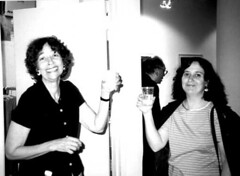
Susan Bee and Corinne Robins*
(Charles Bernstein in background)
taken at the Poetry Plastique show
at the Maryann Boesky Gallery
February 2001
*photo by Toni Simon
Poetry Radio Show with Matthew Shindell and James Meetze-Coming Soon!
Maximum Go in the Resulting Hogshead {click here}
Maximum Go in the Resulting Hogshead {click here}
Monday, March 28
Stacy Doris and Chet Weiner, The Ear Inn, January 1996
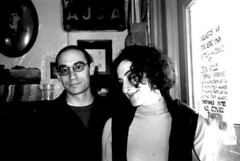
Chet Weiner and Stacy Doris at the Ear Inn,
January 1996*
*photo by Toni Simon
Subscribe to:
Posts (Atom)